
It’s 11pm, you’ve got three tables open, a satellite about to go on break, and the lobby freezes for four seconds. One timebank gone. That single moment tells you more about an online poker platform than any marketing deck, because everything that matters in poker software, server stability, table state syncing, mobile parity, happens in those four seconds.
Which is why a supplier announcement is worth reading closely. BETB2B has rolled out a poker platform built by PIN Projekt, adding a dedicated poker vertical to its B2B offering for operators. On its own that’s a one-line trade story. As a case study, it’s a neat excuse to compare how poker products are actually put together, and to work out what you should demand from one, whether you’re an Indian player picking a room or an operator picking a provider.
BETB2B poker: what the PIN Projekt launch actually signals
The structure of the deal is the interesting part. BETB2B is a platform provider that sells technology to operators rather than running a consumer brand; PIN Projekt is the poker specialist whose software now sits inside that stack. So the poker room an end user eventually logs into is built by one company, distributed by another, and branded by a third.
That three-layer model is now the norm in online poker, and it exists for a simple reason: poker is the hardest casino-adjacent product to build well. Slots are self-contained. Poker needs a shared player pool, synchronised table state across thousands of concurrent seats, tournament scheduling, collusion detection, and a rake engine that accounts for every pot to the paisa. Few operators attempt it in-house anymore. They licence it, the way BETB2B has.
Keep that in mind as a player. When you compare two poker rooms, you’re often comparing two skins over similar engines, or one strong engine against a weak one. Knowing which features come from the software and which from the operator is the whole skill of evaluating betb2b poker-style launches, or any other.
Core poker software features worth comparing
Strip away branding and a poker product is judged on three things: what you can play, when you can play it, and how many people are there with you. The third usually decides the first two.
Game variety and formats
Texas Hold’em is the baseline; no platform ships without it. After that, variety is a liquidity question, not a coding one. Pot Limit Omaha, Omaha Hi-Lo, short deck, and in the Indian market a healthy crossover with games like Teen Patti all look impressive in a lobby, but an empty PLO table is worse than no PLO at all. A modern online poker platform should either have the traffic to support its menu or be honest about running a tight core of well-populated games.
The better question to ask: at the hours you actually play, how many tables are running at your stake? Load the client at 9pm IST on a Tuesday and count. That number beats any feature list.
Tournaments versus cash games
Both are table stakes now, but they stress the software in different ways. Cash games need instant seating, rapid table balancing and clean buy-in handling. Tournaments need a scheduler, late registration, re-entry logic, synchronised breaks, correct ICM-free payout math, and the ability to not fall over when 4,000 players hit the bubble at once. Sit and go and fast-fold pools sit in between.
| Format | Typical session | Swing profile | What the software must nail |
|---|---|---|---|
| Cash games | Open-ended, leave anytime | Moderate, depends on stakes | Fast seating, table balancing, rake cap accuracy |
| Sit and go | 20–60 minutes | Moderate to high | Quick fills, clear payout display, auto re-entry |
| Multi-table tournaments | 3–8 hours | High, long dry spells | Scheduler, late reg, hand-for-hand bubble play, table breaks |
| Fast-fold pools | Flexible, very high hand volume | Smoothed by volume | Instant re-seating, shared pool integrity |
| Spin-style lottery SNGs | 5–15 minutes | Very high, prize-driven | Certified RNG for the prize draw, transparent odds |
If you mostly grind an hour after work, cash games and fast-fold suit you and a weak tournament scheduler barely matters. If you chase Sunday majors, the reverse is true. Judge the platform against your own calendar.
Mobile and multi-device support
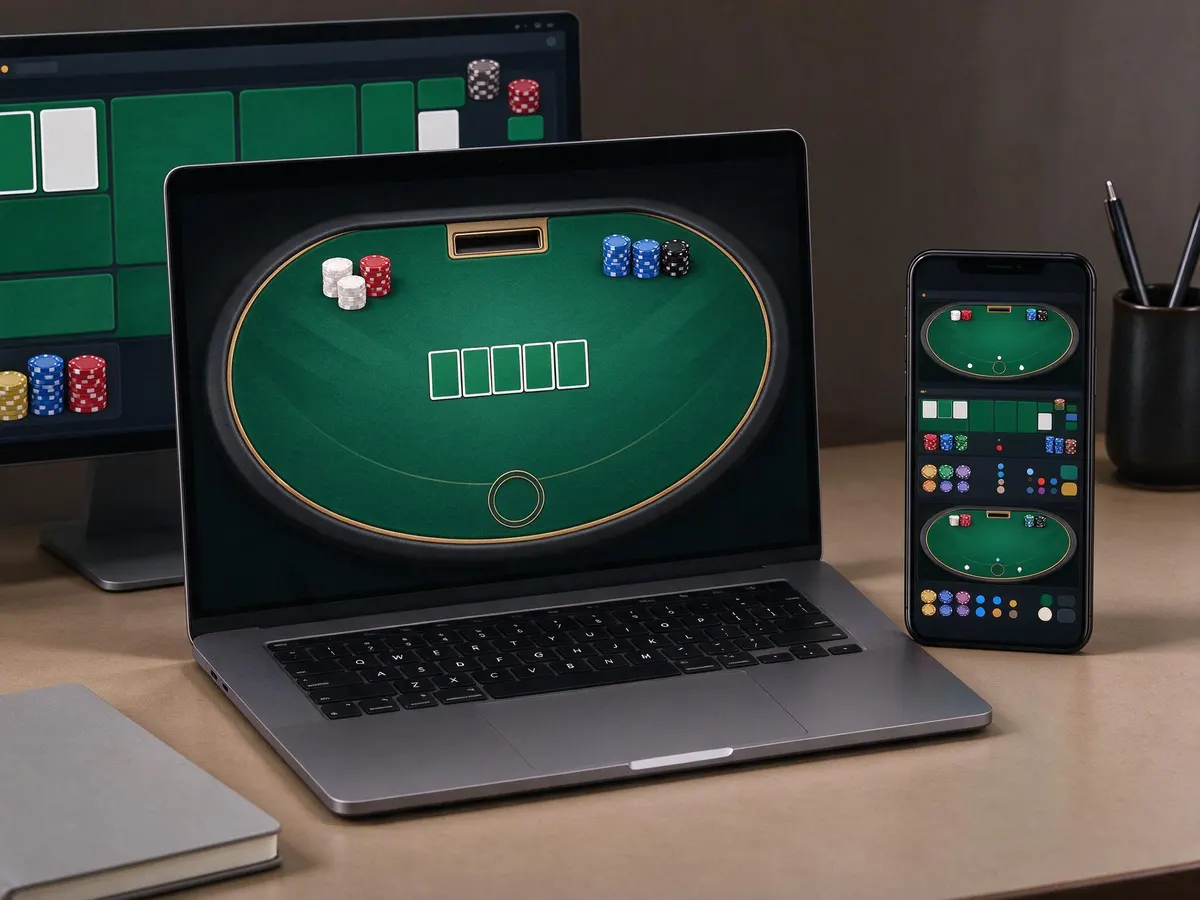
In India, mobile poker is not a secondary channel, it’s the main one. The comparison that matters is parity: can you do everything on the phone that you can do on desktop? Register for tournaments, use timebank, see bet-sizing shortcuts, review hand history, deposit and withdraw? Many clients still quietly drop features on mobile.
Also test behaviour on a flaky connection. A good client reconnects you to the same seat with the clock still running; a poor one dumps you and auto-folds. And check whether session state survives switching from Wi-Fi to mobile data, because it will happen mid-hand sooner or later.
The infrastructure you only notice when it breaks
This is where poker software features stop being cosmetic. Four things carry the product:
- Certified shuffling. Card dealing is driven by a random number generator, and the RNG should be tested by an independent laboratory such as GLI, iTech Labs or eCOGRA. Certification covers the randomness of the shuffle and the integrity of the deal, and the operator should name its testing house rather than wave vaguely at “fair play”.
- Server stability and capacity. Poker traffic is spiky, with peaks around scheduled tournaments. Latency between Indian players and the nearest server node affects how often you feel that four-second freeze.
- Game integrity systems. Collusion detection, chip-dumping alerts, bot detection, multi-accounting checks, and a clear position on whether tracking software and HUD compatibility are allowed. Platforms differ sharply here; some ban HUDs outright to protect recreational players, others permit them. Neither is wrong, but you deserve to know before you buy in.
- Payments. For Indian players this means UPI and bank transfers that work at 1am, realistic withdrawal windows, and KYC that is completed before you win rather than used as a reason to delay a cashout.
One honest note on the money side. Poker is played against other players, not against the house, so there’s no RTP figure in the slots sense. The operator’s income is the rake, a small cut of each pot or tournament buy-in, usually capped. Rake structure therefore matters more than any bonus: a lower cap and a sensible rakeback or loyalty scheme affect your long-run results far more than a one-off welcome offer, and no amount of skill removes the rake from the equation.
Interface design: lobby first, graphics second
Pretty tables sell screenshots. Lobby design sells sessions. The things that actually change how you play online poker games are mundane: filters that remember your stakes, a tournament calendar you can sort by start time and buy-in, waiting lists that notify you properly, and a seating system that doesn’t drop you next to a 200bb stack when you bought in for 40.
For anyone playing more than one table, multi-tabling tools decide everything. Look for tiling and cascading layouts, a reliable “next table to act” focus, stack sizes shown in big blinds, clear pot odds display if offered, four-colour decks, and bet-size hotkeys. Customisation isn’t vanity. On six tables, a half-second saved per decision is the difference between playing well and timing out.
Hand history and basic statistics deserve a mention too. If you want to improve, you need exportable history, and it pairs naturally with the fundamentals covered in our poker strategy guides.
Security, licensing and fair play across poker platform providers
Here’s where comparing poker platform providers gets genuinely useful, because claims are easy and evidence is not. A credible setup shows you: the licence under which the operator runs, the testing lab that certified the RNG, encryption on the client, segregated player funds, and a published set of rules covering disconnections, misdeals and collusion penalties.
Responsible gaming tools belong in the same list, and in modern builds they’re part of the platform rather than an afterthought: deposit limits, loss limits, session reminders, cool-off periods and self-exclusion, all reachable in two taps. If you have to email support to set a deposit limit, that tells you something about the provider’s priorities. Our notes on staying in control while you play cover how to use these properly.
On legality and tax, the position for real money online poker in India has been changing and differs by jurisdiction, so check the current rules that apply to you and treat winnings as taxable income. That’s general information, not legal or tax advice.
What PIN Projekt brings to the table
Judged against the checklist above, the value of a supplier-built poker room like PIN Projekt’s is specialisation. A company whose only product is poker has to solve tournament scheduling, shared liquidity and integrity monitoring properly, because it has nothing else to sell. For BETB2B, licensing that specialism is faster and safer than writing a poker engine from scratch, and operators on the platform get a vertical they could not realistically build alone.
The trade-off is equally real, and it’s worth stating plainly rather than glossing over. With a licensed pin projekt poker product, the player pool depends on how many operator brands sit on the network and how well they market. The software can be excellent and the tables still thin. So treat the launch as a necessary condition for a good room, not a sufficient one.
| Approach | Strength | Weakness | Best suited to |
|---|---|---|---|
| In-house proprietary room | Full control of rake, features, player pool | Very high build and compliance cost | Large operators with existing traffic |
| Licensed specialist software (BETB2B + PIN Projekt model) | Mature poker engine, quick to market | Liquidity depends on the wider network | Operators adding poker to a casino or sportsbook |
| Simple white-label skin | Cheapest entry, minimal technical work | Little differentiation, limited customisation | Smaller brands testing demand |
The verdict: judging a poker room in five minutes
Open the client at the hour you’d normally play. Count running tables at your stake. Check the rake cap in the table info. Open the tournament calendar and see if anything starts in the next 30 minutes. Find the responsible gaming settings, the licence details and the RNG certification. Then do a small deposit and withdrawal before you ever play a serious session.
A platform that passes those six checks is modern in the only sense that counts. The PIN Projekt rollout through BETB2B is a reminder that the engine under the felt is usually someone else’s work, and that the engine is where quality lives, or doesn’t.
Frequently asked questions
What is a modern poker platform?
Software that runs real-money or play-money poker across devices with a shared player pool, certified RNG shuffling, cash games and tournaments, secure payments, integrity monitoring and built-in responsible gaming tools. Most are supplied by specialist providers and branded by operators.
How do online poker platforms work?
The provider’s servers deal cards using a tested random number generator, synchronise table state for every seated player, pool players from one or more operator brands, and take a small rake from each pot or tournament buy-in. Operators handle branding, payments and customer support on top.
What features should poker platforms have?
At minimum: Texas Hold’em plus a few well-populated variants, cash games, sit and go and multi-table tournaments, genuine mobile parity, multi-tabling layouts, exportable hand history, a clear rake structure, published rules on HUD use and disconnections, and limits plus self-exclusion tools you can set yourself.
Does a bigger platform mean better odds for me?
Not in the house-edge sense, since you play against other players. A larger player pool means more games at your stake and faster seating, while the rake and the standard of the field determine your long-run results. Poker involves skill and chance, and losing sessions are part of it, so only stake money you can afford to lose and use deposit limits from the start.