

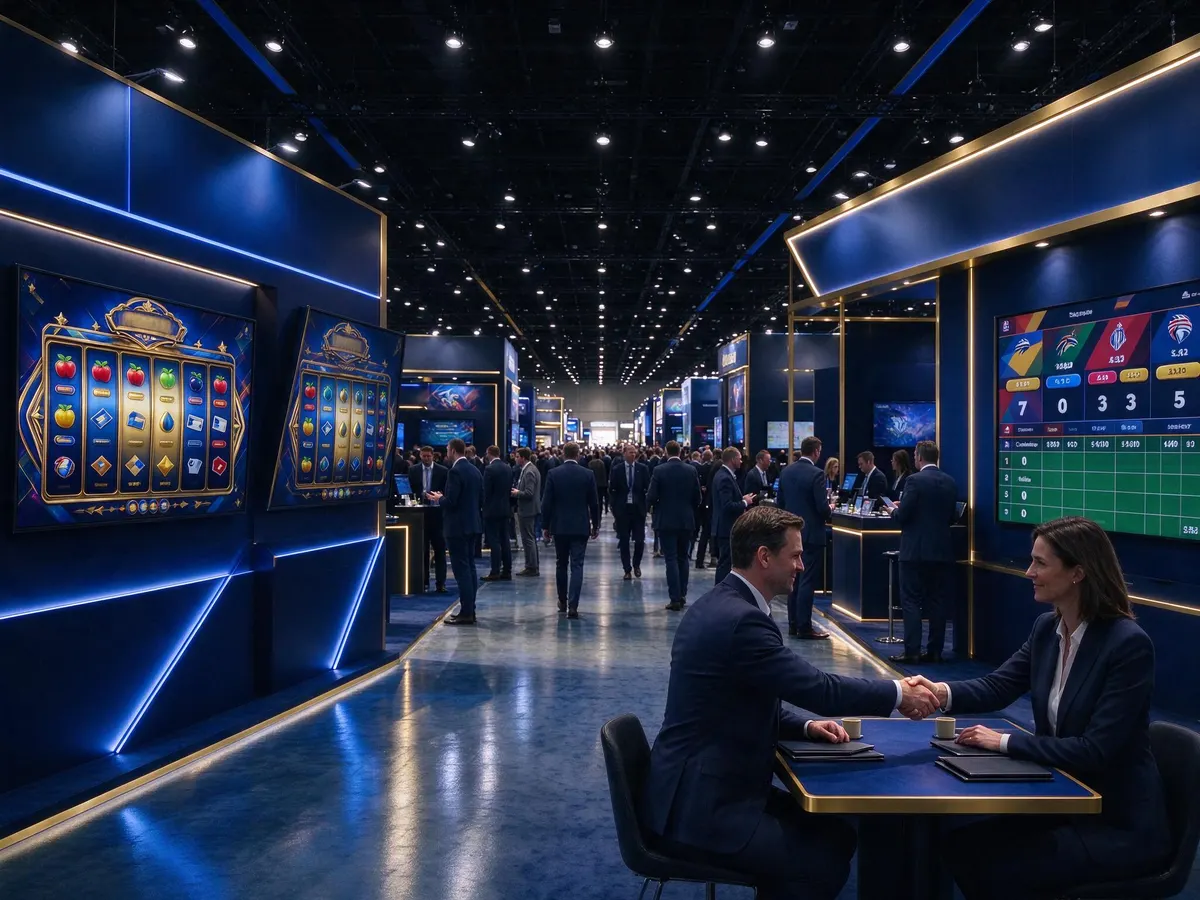
If an online casino can run its servers in the cloud, hire a compliance director it has never met in person, and sign a supplier contract by e-signature, why does it still pay serious money for floor space at a convention centre? That question comes up every year, and every year the biggest operators and suppliers answer it the same way: they book the stand again. iGaming trade shows survive in a fully digital industry because some business, particularly anything involving licences, money movement, or trust, still moves faster across a table than across a screen.
The paradox: digital-first companies buying physical floor space
An online gambling operator is about as digital as a business gets. Players never visit an office. Games are delivered by API. Marketing runs through affiliate dashboards and ad platforms. Teams are spread across Malta, Yerevan, Manila and Bogotá, coordinating on Slack.
And yet the spend on exhibitions keeps going up. A mid-size supplier might budget for stand space, build and shipping, staff travel, side events and sponsorships, then repeat that two or three times a year on different continents. For a large operator, the annual exhibition calendar is a real line item, often managed by a dedicated events lead inside business development.
The honest explanation is not nostalgia for airport lounges. It’s that the parts of this industry that can’t be automated, deciding who to trust with your player funds, your licence exposure, or your game content, are exactly the parts that happen in rooms. Everything else moved online years ago. The hard bits stayed human.
Licensing and regulatory relationships you can’t build by email
Casino industry exhibitions have quietly become one of the few places where operators, regulators and licensing consultants are in the same building at the same time. Regulators from established jurisdictions and from newly regulating markets attend panels, run jurisdiction stands and take meetings. Compliance consultants, law firms and test labs set up alongside them.
Why does that matter? Because market entry is rarely a form-filling exercise. A team weighing up a new licence needs to understand how a specific authority interprets its own rules: what counts as adequate player-funds segregation, how quickly applications actually get processed, what the regulator’s current enforcement priorities are, whether a local entity and local directors are expected. You can read the published framework from a body like the Malta Gaming Authority or the UK Gambling Commission in an afternoon. Learning how it feels in practice takes conversations with people who have been through it, plus the regulator’s own staff answering follow-up questions on the spot.
There’s a second benefit that’s harder to put on a slide: being known. When a licensing body has met your compliance lead, heard your responsible gambling approach explained in person, and seen you turn up two years running, you stop being a name on an application. That doesn’t buy leniency, and nobody should pretend it does. It does reduce friction, and in a sector where a licence decision can gate an entire year’s revenue plan, friction costs money.
Where B2B deals actually get signed
The stereotype of B2B gambling events is free coffee and branded tote bags. The reality for commercial teams is a diary carved into 20 and 30 minute slots, booked weeks in advance, with the stand working as a meeting room rather than a billboard.
The deal types cluster into a few categories:
- Content and aggregation — operators meeting game studios and aggregators to negotiate exclusivity windows, revenue share, launch calendars and which titles get promoted where.
- Platform and sportsbook supply — the biggest single technology decision most operators make, and one almost nobody commits to without meeting the team behind it.
- Payments — local rails are market-by-market work. Getting UPI working properly in India, Pix in Brazil or mobile money across parts of Africa means talking to providers who understand local banking relationships and approval rates, not just integration docs.
- Affiliates and media — networks, super-affiliates and publishers negotiating CPA and revenue share terms, often over dinner rather than at a stand.
- Compliance and certification — test labs, RNG and RTP certification, geolocation, KYC and age-verification vendors.
No serious agreement is finalised on a handshake. Contracts still go through legal, due diligence and integration planning afterwards. But the handshake collapses the slow part. A first meeting that would have taken six weeks of email ping-pong to arrange happens in the first hour of day one, and the second and third meetings happen before the show closes.
Here’s roughly who a business development team meets and what tends to come out of it:
| Who they meet | Typical conversation | What it can lead to |
|---|---|---|
| Licensing authorities and jurisdiction stands | Application requirements, timelines, local presence rules | A clearer market-entry plan, or a decision not to enter |
| Game studios and aggregators | Roadmaps, exclusivity, commercial terms | Content deals and launch slots |
| Payment providers | Local methods, approval rates, settlement and payout speed | New deposit and withdrawal options per market |
| Affiliate networks and media | Traffic quality, commission models, market coverage | Acquisition partnerships |
| Test labs and compliance advisers | Certification scope, RG tooling, audit readiness | Smoother licence applications and renewals |
| Rival operators | Market conditions, tax changes, hiring | Market intelligence and occasionally M&A talks |
Trust is the real currency in a regulated industry
Online gaming networking carries more weight here than in most sectors, and the reason is regulatory exposure. If a payment partner mishandles player funds, if an affiliate advertises to minors, if a supplier’s game fails certification in a licensed market, the operator holding the licence takes the consequences. Fines, licence conditions, suspended market access.
That shared liability changes how people vet each other. Due diligence documents tell you a company’s registration and ownership. They don’t tell you whether the account manager will pick up the phone at 11pm when payouts are failing, or whether the founder will be straight with you about a problem rather than quietly managing it. Those judgements get made in person, and experienced commercial people will say openly that they have walked away from good paper after a bad meeting.
There’s also the reference network. In a sector where reputations travel fast and the pool of serious counterparties is smaller than it looks, a quiet conversation at the bar about how a supplier behaved during a dispute is worth more than any sales deck. Those conversations only happen with people who know you.
What digital networking still can’t replicate
Video calls are better than they were, and plenty of partnerships now run for years without the parties sharing a room. What iGaming conferences give you that a calendar invite doesn’t:
- Unplanned meetings. The partner you didn’t know existed, met in a queue, is a genuine pattern. No targeted outreach surfaces a supplier you’ve never heard of.
- Parallel conversations. Three people from your team can hold nine meetings in a morning in the same place. Remotely, that’s a month of scheduling across time zones.
- Candour. People say things off the record that they will never put in writing: what a tax change is really doing to margins, which market is about to get harder, why a deal fell apart.
- Reading a product properly. Watching someone demo a back office live, asking awkward questions, seeing which features they skip, beats a polished recorded walkthrough.
- Reading the mood. Which halls are full, who has downsized their stand, what every third panel is about. That’s a sentiment read you can’t get from a report.
How brands actually measure whether it was worth it
Most marketing teams know the honest answer: attribution here is messy, and anyone quoting a neat ROI figure for a trade show is probably rounding generously. iGaming sales cycles run long. A conversation in October can become a signed platform contract the following summer, by which point three other touchpoints have claimed credit.
So the better operators measure a mix of things:
- Meetings held versus booked, with a quality rating on each, rather than raw badge scans.
- Cost per qualified meeting, compared against what the same pipeline would cost through outbound or paid channels.
- Deal velocity — whether opportunities touched at the show close faster than those that weren’t.
- Retention conversations. A large share of stand time goes to existing partners. Renewals and upsells are an outcome, even if they look unglamorous.
- Market intelligence and regulatory insight, written up as a post-show briefing that feeds next year’s market-entry decisions.
- Hiring. Senior iGaming talent is scarce, and a lot of it changes jobs off conversations started at these events.
Some of that budget is plainly brand spend, and firms should call it that. Being visibly present signals to regulators, partners and investors that a company is stable and intends to stay. The ones who get poor value are usually the ones who show up with a stand, no meeting diary and no follow-up plan, then conclude that exhibitions don’t work.
Worth noting that responsible gambling has moved from a side panel to a main-stage topic at most serious shows, with regulators pressing operators on player-protection tooling, affordability checks and advertising standards. That shift is one more reason the room still matters: those expectations get set in conversation long before they appear in a rulebook.
Frequently asked questions
Why do iGaming brands attend trade shows?
Mainly to compress business development and regulatory work into a few days: meeting licensing authorities, negotiating with game studios, payment providers and affiliate networks, vetting partners face to face, and gathering market intelligence that isn’t published anywhere.
What happens at casino conferences?
Exhibition halls of supplier stands used as private meeting rooms, conference programmes on regulation and technology, jurisdiction pavilions where licensing bodies take questions, product demos, awards, and a heavy schedule of invite-only dinners and side events where much of the real talking happens.
How do online casinos network?
Through a mix of channels: LinkedIn and warm introductions year round, industry media and affiliate relationships, and then concentrated in-person rounds at the major shows, where commercial teams book back-to-back meetings with existing and prospective partners.
Are gambling exhibitions worth it?
For companies with a prepared meeting diary, defined objectives and disciplined follow-up, usually yes, measured on qualified meetings, deal velocity and partner retention rather than lead counts. For companies that just rent a stand and hope, generally not.
This article covers the business side of the gambling industry. If you play, treat it as entertainment, set deposit and time limits, and use self-exclusion tools if gambling stops being fun.