

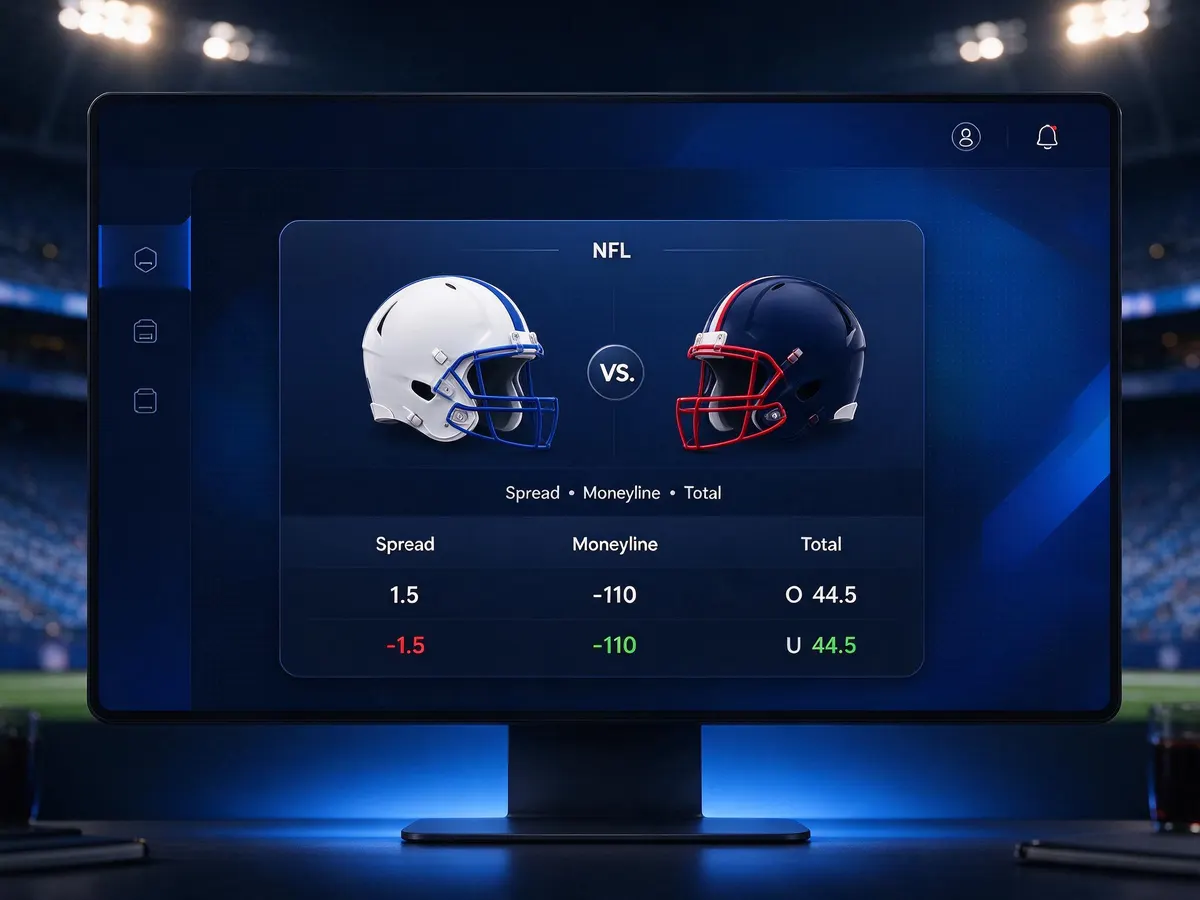
The point spread is not a prediction of the final score. That is the first thing to unlearn if you want to understand how NFL odds work. When a sportsbook posts Philadelphia Eagles -3.5 against the Chicago Bears, nobody is forecasting a 3.5-point margin. The number is a handicap designed to pull roughly equal money to both sides, and the price attached to it is where the house takes its cut.
Below, a real Monday Night Football market between the Eagles and the Bears is used as the teaching case. Same game, three different bets, three different ways of being right.
What a betting line actually is
A betting line is the full set of prices a sportsbook offers on a game. For almost any NFL match, three markets sit side by side:
- Moneyline — who wins, margin irrelevant.
- Point spread (also called the handicap) — who wins after one team is given or docked points.
- Total, or over/under — whether both teams’ combined points land above or below a posted number.
Here is the Eagles–Bears line in the form those three markets took:
- Philadelphia moneyline -186, Chicago moneyline +186
- Philadelphia -3.5 priced at -104 (so Chicago +3.5 sits on the other side)
- Total 41.5 points, Over priced at +100
Reading betting lines is mostly a matter of separating two things: what has to happen for the bet to win, and what it pays if it does. Beginners blur the two constantly.
Point spread explained: Eagles -3.5 does not mean “Eagles win”
Myth: back the favorite on the spread and you just need them to win the game. Reality: a -3.5 favorite has to win by 4 or more. Three points is the most common margin in the NFL, and the spread exists precisely to make that margin matter.
Reading the spread numbers
The minus sign marks the favorite and the points are subtracted from its score. Plus marks the underdog and the points are added.
- Philadelphia -3.5: take the Eagles’ final score, subtract 3.5, and they must still be ahead.
- Chicago +3.5: add 3.5 to the Bears’ score. They win the bet if they win outright or lose by 3 or fewer.
Run two scorelines through it. The Eagles beat Tennessee 24-20 the week before this game, a 4-point margin. Apply the handicap: 24 − 3.5 = 20.5 against 20, so Eagles -3.5 would have cashed, barely. Shift it to 23-20 and the Eagles win the game while losing the bet, because 19.5 is less than 20.
That half point is not a gimmick. On a whole number such as -3, a 3-point win is a push and stakes are returned. The hook (the .5) removes the push entirely, so every result produces a winner and a loser.
Calculating spread payouts
Spread prices cluster around even money because the handicap already balances the teams. In this market, Philadelphia -3.5 was priced at -104.
For negative (minus) odds, profit = stake × 100 ÷ odds. A ₹1,000 bet at -104 returns ₹1,000 × 100 ÷ 104 = ₹961.54 profit, ₹1,961.54 back in total. You are risking ₹104 to win ₹100, which is the juice (or vig) in its simplest form.
The far more common sportsbook price is -110 on both sides: a ₹1,000 stake wins ₹909.09. At -104 the cut is thinner, which matters more than beginners assume — see the probability section below.
Moneyline vs spread: you are paying for certainty
Myth: the moneyline is the “safe” bet because you only need your team to win. Reality: you pay heavily for that simplicity when you back a favorite, and the underdog price is not generosity, it reflects a genuinely lower chance of winning.
Favorite vs underdog odds
American odds are quoted around a ₹100-style unit:
- Negative odds (-186) show how much you must stake to win 100. This side is the favorite.
- Positive odds (+186) show how much you win from a 100 stake. This side is the underdog.
Philadelphia at -186 was the favorite, Chicago at +186 the underdog, with Chicago missing its starting quarterback for the game. The spread and the moneyline describe the same expectation in two different currencies: the moneyline shifts the price, the spread shifts the goalposts.
Moneyline payout examples
Using a ₹1,000 stake throughout:
| Bet | Odds | Profit on ₹1,000 | Total return |
|---|---|---|---|
| Philadelphia moneyline | -186 | ₹537.63 | ₹1,537.63 |
| Chicago moneyline | +186 | ₹1,860.00 | ₹2,860.00 |
| Philadelphia -3.5 | -104 | ₹961.54 | ₹1,961.54 |
| Over 41.5 points | +100 | ₹1,000.00 | ₹2,000.00 |
The formulas: for minus odds, stake × 100 ÷ odds. For plus odds, stake × odds ÷ 100. That is the whole of it.
Notice the trade-off. Backing the Eagles to win straight up returns about ₹538 per ₹1,000. Backing them to win by 4 or more returns about ₹962 — nearly double, because you have accepted a harder condition.
Over under totals: the number covers both teams
Myth: the total is a line on how much the favorite will score. Reality: it is both teams’ points added together, including overtime at most books, and the identity of the scorer is irrelevant.
The Eagles–Bears total was 41.5, with the Over at +100. Combined points of 42 or more wins the Over; 41 or fewer wins the Under. A 24-20 finish gives 44 points, an Over. A 21-20 finish gives 41, an Under. Again, the half point kills the push.
Totals are also split by team. In this market, Philadelphia Over 23.5 points was priced at +104 and Chicago Over 18.5 points at -104. Add those two team totals and you get 42, which sits within a point of the game total of 41.5. That consistency is not a coincidence; the game total is built from expectations for each offense.
Reading a complete Monday Night Football line, number by number
Pull up this Monday Night Football betting market on a sportsbook or exchange and it will look roughly like the grid below. Away team is conventionally listed first.
| Team | Spread | Moneyline | Total | Team total |
|---|---|---|---|---|
| Philadelphia Eagles | -3.5 (-104) | -186 | O 41.5 (+100) | O 23.5 (+104) |
| Chicago Bears | +3.5 | +186 | U 41.5 | O 18.5 (-104) |
Decoded: the team with the minus spread is the favorite; the number in brackets is the price, not the handicap; O and U are Over and Under on the same posted number; and the team totals are separate markets on each offense. Some books display decimal odds instead (1.54 rather than -186), and Indian-facing sites often default to decimals. Decimal odds show total return per unit staked, so 1.54 on a ₹1,000 bet returns about ₹1,540 including the stake.
How NFL odds work as probability
Every price is a probability wearing a disguise. Converting odds back into a percentage is the single most useful habit a beginner can build.
For minus odds: odds ÷ (odds + 100). For plus odds: 100 ÷ (odds + 100).
| Odds | Calculation | Implied probability |
|---|---|---|
| -186 (Philadelphia win) | 186 ÷ 286 | 65% |
| +186 (Chicago win) | 100 ÷ 286 | 35% |
| -104 (Eagles -3.5) | 104 ÷ 204 | 51% |
| +100 (Over 41.5) | 100 ÷ 200 | 50% |
| +104 (Eagles Over 23.5) | 100 ÷ 204 | 49% |
The Eagles–Bears moneyline pair adds up to exactly 100% (65 + 35), which tells you these prices came from a market without a built-in bookmaker margin. A traditional sportsbook does not work that way. Price both sides of a spread at -110 and each implies 52.38%, for a total of 104.76%. That extra 4.76% is the overround, and with balanced action the book keeps roughly 4.5% of everything staked. It is the same structural edge as the house edge in a casino game, just expressed through prices instead of a wheel.
“Value” means nothing more than this: you think the true probability is higher than the implied probability in the price. If you genuinely rate Chicago’s chance at 40% and the market offers +186 (35%), that is a value bet by your own numbers. The catch is that your estimate has to be better than the market’s, after the margin, consistently. Most bettors’ estimates are not, which is why the long-run expectation on sports betting is negative. Nothing in this article changes that, and no bet type listed here is safer than another in any meaningful sense.
Common questions about reading NFL lines
How do I read NFL betting lines as a complete beginner?
Read left to right: team, spread, moneyline, total. Minus means favorite, plus means underdog. The number in brackets is the price. Work out what has to happen first, then calculate the payout.
What does the point spread mean?
It is a handicap in points. Eagles -3.5 means the Eagles’ score is cut by 3.5 for settlement, so they must win by 4 or more. Bears +3.5 means they get 3.5 points added and can lose by up to 3 and still win the bet.
How do moneylines work?
You pick the outright winner. At -186 you stake ₹186 to win ₹100; at +186 you stake ₹100 to win ₹186. Margin of victory does not matter.
What is over/under betting?
A bet on the combined score of both teams against a posted number, such as 41.5. Totals of 42+ settle Over, 41 or fewer settle Under.
Why do lines use half points?
To remove ties. On a whole number, an exact match is a push and stakes are refunded. Half points force a result.
One practical note before you place anything: betting rules in India differ by state and platform, so check what applies where you live. Set a deposit limit before you start, treat the money as the cost of entertainment rather than income, and use the cool-off or self-exclusion tools your operator offers if it stops being fun. If gambling is causing harm, support services are available, and stepping away is always the better bet.