

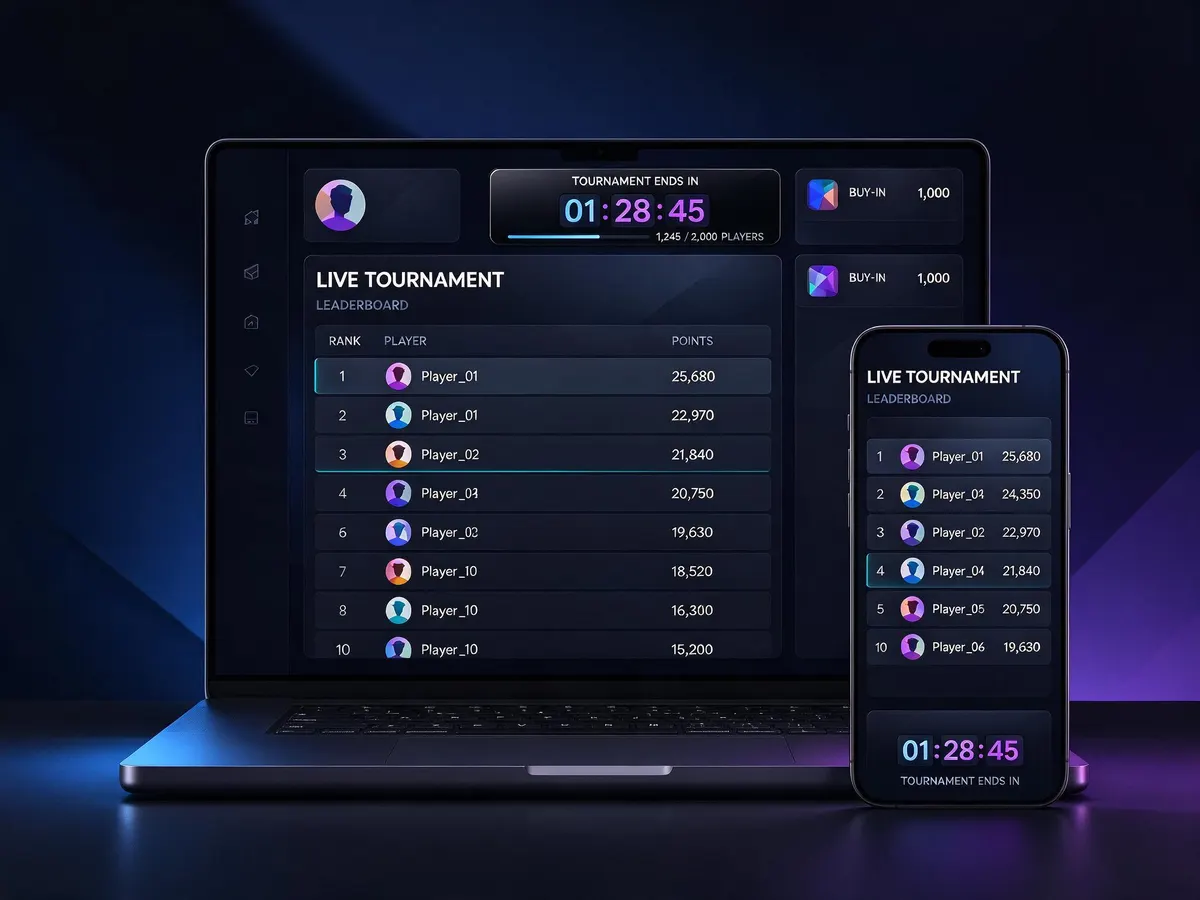
In a 500-player slot tournament that pays the top 20 finishers, 480 people finish with nothing extra. That is not a bug in the format. That is the format. And it is exactly why the casino tournament platform has quietly become one of the most sought-after pieces of software in online gambling: a leaderboard turns the same spins into a contest, and contests hold attention far longer than a solo session does.
The latest entrant is ThrillArena, a tournament platform launched by supplier ThrillTech in late September 2026 and reported across industry trade press. The product itself matters less than what it represents. Tournament tech has gone from a novelty bolted onto a casino lobby to a category suppliers now build and sell on its own.
ThrillArena and the race to own the leaderboard
ThrillArena is tournament gaming software: a layer that sits across an operator’s existing game library and runs competitive events on top of it. Players keep spinning the same slots they already play, but their results are scored, ranked and displayed against everyone else in the event.
Public detail on the rollout is still thin, as it usually is with B2B launches, so treat any feature list you see with mild suspicion until an operator actually goes live with it. What is notable is the timing and the positioning. ThrillTech is selling tournaments as a standalone engagement product rather than a seasonal promotion, which is the direction the whole segment has moved. Competing suppliers have been shipping similar tools for years, and operators now shop for them the way they shop for payment providers.
If you want the short version of why: acquisition in regulated markets is expensive, retention is cheaper, and a tournament is a retention mechanic that costs a fixed prize pool instead of an open-ended bonus liability.
Myth: a tournament is just a normal session with a scoreboard
It looks that way from the lobby. Mechanically, a casino tournament platform changes three things: what counts, when it counts, and who you are being measured against.
Structure and rules
Most events are defined by a window and a qualifying condition. The window can be 15 minutes, a weekend, or a month. The condition is usually a minimum qualifying bet (say ₹20 per spin) on a specified list of games. Bets below the minimum, or on games outside the list, simply do not score. People lose events on that technicality constantly.
Two broad shapes exist. Fixed-spin tournaments give every entrant the same number of spins, which puts everyone on roughly level footing. Open-entry leaderboard events let you play as much as you like inside the window, which rewards volume as much as luck. Read which one you have joined before you start, because the sensible approach to each is completely different.
Scoring and leaderboards
Raw cash won is rarely the metric, because that would just rank players by stake size. Common scoring models include:
- Win multiplier — your biggest single win divided by your bet, so a ₹10 stake and a ₹1,000 stake can compete fairly.
- Cumulative points — points accrue for qualifying spins, with bonus points for features triggered or wins above a threshold.
- Best-of-X spins — only your top-scoring spins in the window count, which smooths out dead runs.
- Prize drops — not a leaderboard at all, strictly speaking: random prizes land on qualifying spins during the window.
Real-time scoring is the part players actually feel. A leaderboard that updates instantly, with your position visible in an overlay while you play, is the whole product. The gamification is the point, and suppliers know it.
Prize pool distribution
Prize pools are almost always top-heavy. A common pattern gives the winner 20–30% of the pool, with the remainder tapering sharply across the paid places. Expect anywhere from the top 3 to the top 200 to be paid depending on field size.
The detail worth checking before you enter: whether the prize is cash or bonus funds. Cash is cash. Bonus funds carry a wagering requirement, and a ₹5,000 “prize” with a 30× playthrough means ₹150,000 must be wagered before anything can be withdrawn. Operators are not obliged to make that obvious in the promo banner. It will be in the terms.
Myth: operators run tournaments as a favour to players
They run them because the numbers work. A tournament concentrates play into a defined window, which smooths out traffic troughs and gives marketing something to push on a Tuesday afternoon. Session lengths stretch. Return visits increase when there is a leaderboard position to defend.
There is also a cost argument. A deposit bonus is an open liability that scales with uptake. A tournament prize pool is a fixed number agreed in advance, paid out regardless of whether 200 or 2,000 people enter, which makes the promotional spend far easier to forecast.
Differentiation does the rest. Most online casinos run broadly the same slots from the same studios, so the lobby is hard to distinguish on content alone. Tournament gaming software is one of the few layers an operator can use to make an identical game library feel like a different product. Network tournaments go further, pooling players across multiple operators so even small brands can advertise a large field and a serious prize pool.
Myth: all online casino tournaments are the same thing
The formats behave quite differently, and the cost of entry varies from nothing to substantial.
Slot tournaments
The default format, and the easiest to run. Entry is usually free, qualification is a minimum bet on selected slots, and scoring leans on win multipliers or points. Slots suit tournaments because results arrive fast and everyone understands a spin.
Table game and live dealer competitions
Blackjack, roulette and baccarat events are scored on hands or rounds played and the size of wins relative to stake. Live dealer competitions have grown alongside them, often on game show style titles where the multipliers are large enough to produce a dramatic leaderboard. Indian card games such as Teen Patti and Andar Bahar now appear in operator leaderboards too, since they are already streamed live and already popular.
Freeroll versus buy-in
Freerolls cost nothing beyond the bets you were going to place anyway. Buy-in events charge an entry fee, often with the pool funded by those fees, and are most familiar from online poker. Buy-ins tend to mean smaller fields and bigger relative prizes; freerolls mean large fields and long odds.
| Format | Typical entry | Usual scoring | Suits |
|---|---|---|---|
| Slot leaderboard | Free, min qualifying bet | Win multiplier or points | Casual players already spinning |
| Fixed-spin slot event | Free or small fee | Best score across set spins | Players wanting a capped cost |
| Live dealer / table event | Free, min qualifying bet | Wins relative to stake | Table and live game regulars |
| Poker buy-in tournament | Entry fee | Chip stack, last players paid | Skill-based competitive play |
| Prize drop | Free, min qualifying bet | Random awards on spins | Short sessions, low commitment |
Myth: tournaments improve your odds
They do not change the game’s maths at all. A slot with 96% RTP still returns about ₹96 per ₹100 wagered over the long run, still has a 4% house edge, and its RNG does not know a leaderboard exists. What a tournament adds is an extra, separate prize pool funded by the operator on top of normal gameplay.
That makes the honest framing simple. Entering a freeroll you would have played anyway adds a chance at something extra at no additional cost. Increasing your stakes to climb a leaderboard raises your expected loss, because you are wagering more against the same house edge. Chasing a position is where tournaments get expensive, and the leaderboard is designed to make chasing feel reasonable.
On format choice, the one genuinely useful observation is about variance. If a leaderboard is ranked on biggest win multiplier, a low volatility slot with frequent small wins is unlikely to produce a top score, whatever your bankroll. High volatility games produce the outlier results that win those events. That is an observation about which outcomes the scoring rewards, not a way to beat the game.
Joining a tournament in India without losing the plot
The practical sequence at most sites is unremarkable:
- Check the promotions or tournaments tab for live and upcoming events, with their windows and qualifying games.
- Opt in where required. Some events auto-enrol you on your first qualifying bet; others need an explicit click, and missing it voids your scores.
- Confirm the minimum qualifying bet and the eligible game list.
- Complete KYC early. Prizes cannot be withdrawn on an unverified account, and sorting documents after a win is the slowest possible version of that process.
- Read whether prizes are cash or bonus funds, and note any wagering requirement or max cashout.
A few India-specific points. UPI is the common deposit and withdrawal route, and payout speed depends on the operator rather than the tournament. Net winnings from online games are taxable in India and platforms deduct tax at source, so the figure that reaches your account will be lower than the headline prize; treat that as general information and check your position with a tax professional. The legal position has also changed fundamentally: under the Promotion and Regulation of Online Gaming Act, 2025, real-money online gaming is prohibited nationally across India rather than being left to individual states to regulate differently, and some states such as Telangana and Andhra Pradesh had their own prohibitions in place before that. Confirm the current legal position that applies to you before depositing anywhere.
Finally, the obvious thing that leaderboards are built to make you forget: a countdown timer and a ranking are engineered to extend your session. Set deposit and loss limits before you enter, use session reminders, and treat the prize pool as a possible extra rather than a reason to play more than you planned. Gambling costs money over time by design. If it stops being entertainment, the self-exclusion and cool-off tools are in the same account settings menu as the limits.
FAQ
How do casino tournaments work?
You opt into an event with a set time window, place bets at or above a minimum stake on eligible games, and your results are converted into points or a win multiplier score. A leaderboard ranks entrants in real time, and a fixed prize pool is shared among the top finishers.
What is ThrillArena?
ThrillArena is a tournament platform launched by supplier ThrillTech in late September 2026. It is business-to-business software that operators integrate to run competitive leaderboard events across their existing casino games.
Why are casinos launching tournaments now?
Because retention is cheaper than acquisition, prize pools are a fixed and predictable promotional cost, and tournaments are one of the few ways to differentiate a lobby that shares the same games as every competitor.
Are tournament prizes always cash?
No. Many are paid as bonus funds with wagering requirements and sometimes a maximum cashout. The terms attached to the prize matter as much as its size.