

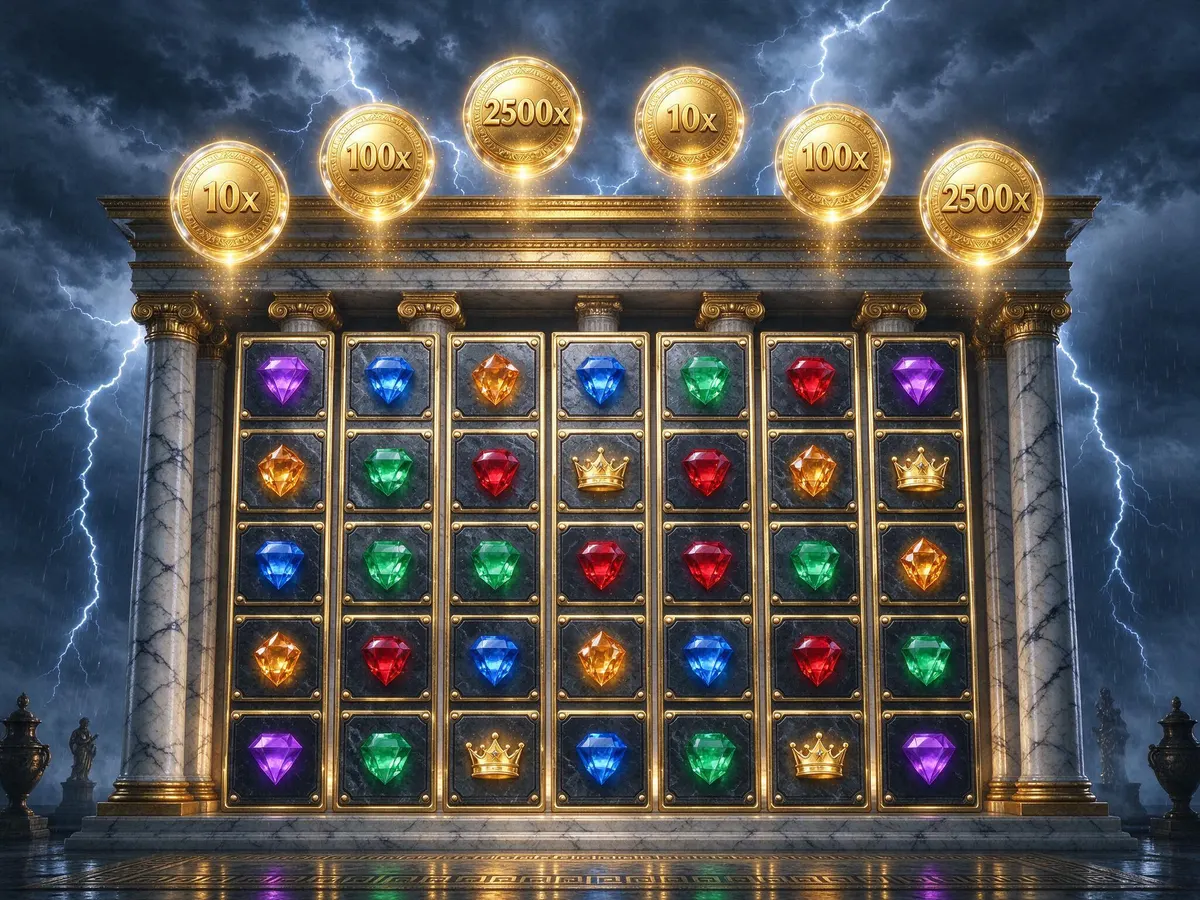
Gates of Olympus 2500 is Pragmatic Play’s sequel to Gates of Olympus, and the headline change is simple: multiplier symbols now reach 2,500x instead of the original’s 500x ceiling.
That sentence is true, and it’s also the part most players misread. A 2,500x multiplier symbol is not a 2,500x win, it’s not a guaranteed feature, and it doesn’t make the game “pay more” in any reliable sense. What it does change is the shape of your sessions, and that’s worth understanding before you load it up. Let’s walk through one spin from first click to final payout, then pull the comparisons out of it.
What is Gates of Olympus 2500
Gates of Olympus 2500 is the latest instalment in Pragmatic Play’s Greek mythology slot series, keeping Zeus, the 6×5 grid and the tumble mechanic that made the first game a staple, while raising the top multiplier symbol value to 2,500x and adding a pre-feature wheel that decides which of four bonus rounds you play.
It arrived as one of the studio’s “mega releases”, following Sweet Rush Bonanza and Fury of Anubis. Within the Gates family it sits as a direct sequel rather than a reskin: the DNA is recognisable from the first spin, but the multiplier layer and the bonus structure have been rebuilt.
If you’ve played the original, the useful mental model is this: same engine, bigger numbers bolted onto the multiplier system, and more decisions handed to a wheel instead of a single fixed free spins mode.
How Gates of Olympus 2500 works, one spin at a time
Here’s the walkthrough. Say you set a stake and hit spin.
Grid layout and symbols
You get a 6×5 grid, 30 symbol positions in total. There are no paylines. The paytable works on counts instead: land eight or more matching symbols anywhere on the reels and you’re paid, regardless of where they sit. That’s why clusters of low-value gems scattered across the whole grid still count.
The symbol set follows the series template, coloured gems at the bottom end and Zeus-themed icons (crown, hourglass, ring, chalice) at the top. A crown cluster pays considerably more than a blue gem cluster of the same size, so an eight-symbol win can be anything from a fraction of your stake to a meaningful multiple of it. Scatter symbols sit outside the paytable and only matter for triggering the bonus.
Tumble feature mechanics
This is where a single spin stops being a single event. When your eight-plus cluster pays, those symbols are removed and new ones drop into the gaps. If the new arrangement forms another winning cluster, it pays and tumbles again. The sequence only ends when a drop produces no win.
So one spin can be one payout or eight consecutive ones. Two things follow from that, and they matter for how you read your balance:
- Your stake is charged once per spin, not once per tumble. A long cascade costs you nothing extra.
- Multiplier symbols that land at any point during the sequence are held aside and applied at the end, to the combined total of that sequence.
That second point is the engine of the whole game. A modest cascade that happens to catch multipliers is worth more than a big cascade that catches none.
Multiplier symbol system
Multiplier symbols can land on any spin or any tumble, in base play or in the bonus, and they carry a value up to 2,500x. They don’t need to be part of a winning cluster. If more than one lands within the same spin, the values are added together and the sum is applied to the total win for that spin.
Work the arithmetic through once and it clicks. Your tumble sequence pays a combined 1.4x your stake. Two multiplier symbols landed during it, a 10x and a 25x. Those add to 35x, and 1.4 × 35 = 49x your stake for the spin. Flip the inputs: a 50x multiplier on a sequence that paid nothing is worth exactly nothing, because there’s no win to multiply.
The 2500x multiplier cap: what actually changed
In the original Gates of Olympus, multiplier symbols ran from 2x to 500x. In Gates of Olympus 2500, the top of that range is 2,500x, a fivefold increase in the ceiling.
Be precise about what that means. 2,500x is the largest value a single multiplier symbol can display, not a cap on your win and not a typical outcome. Pragmatic weights these values heavily toward the bottom of the range, which is why the 2x, 3x and 5x symbols are the ones you’ll actually see. The extreme values exist at the far tail of the distribution, and most players will never land one. Treating the number on the box as a realistic target is the fastest way to misjudge the game.
What the raised ceiling genuinely does is stretch the top end of the outcome distribution. The gap between a good spin and an exceptional one widens. Because multiplier values on the same spin combine, the theoretical ceiling scales with how many symbols land together, not just with the single highest value.
One more thing to check yourself rather than take from any review: the game’s stated maximum win and its exact RTP configuration appear in the in-game information panel at the operator you’re playing at. Multiplier caps and max win caps are separate figures, and operators can run different RTP versions of the same Pragmatic Play title.
Gates of Olympus vs Gates of Olympus 2500: the main differences
Side by side, with the confirmed mechanics only.
| Feature | Gates of Olympus | Gates of Olympus 2500 |
|---|---|---|
| Grid | 6×5, pay-anywhere | 6×5, pay-anywhere |
| Win condition | 8+ matching symbols | 8+ matching symbols |
| Win engine | Tumble (cascading) wins | Tumble (cascading) wins |
| Multiplier symbol range | Up to 500x | Up to 2,500x |
| Multiplier handling | Values combined, applied to total win | Values combined, applied to total win |
| Free spins trigger | 4+ scatters, 15 free spins | 4+ scatters, 15 free spins |
| Bonus structure | Single free spins mode | Pre-feature wheel selects one of four bonus rounds |
| Super modes | None | Two super free spins modes with a 10x minimum multiplier |
| RTP / max win | Check in-game info panel (operator-configurable) | Check in-game info panel (operator-configurable) |
Read that table and the design intent is obvious. The base loop is deliberately untouched, so anyone who knows the original plays the sequel without instruction. All the new work sits in the multiplier range and the bonus layer.
Free spins, scatters and the bonus wheel
Back to the walkthrough. Four or more scatters land anywhere on the grid, and you’re into 15 free spins, same trigger and same count as the original Zeus slot game.
Then the sequel does something new. Before the spins start, a pre-feature wheel decides which of four bonus rounds you actually play. Two of those are super free spins modes that come with a 10x minimum multiplier, meaning the multiplier symbols that land in those modes start from a floor rather than from 2x.
That floor is the part worth thinking about. In the original’s bonus, a spin that caught three multiplier symbols might total 2x + 3x + 4x = 9x. With a 10x minimum, the equivalent spin can’t fall below 30x. The bonus still depends entirely on landing paying clusters first, because a 30x multiplier on a dead spin is worth zero, but when the clusters do arrive the multiplication starts from a much higher base.
The flip side: you don’t choose your mode. The wheel does. Two of the four rounds are the super modes, so the stronger versions are not the default outcome, and a triggered bonus can land you in a standard round instead. For the exact rules of each of the four modes, read the in-game paytable in the version you’re playing, since that’s the only authoritative source.
Where it’s permitted, Pragmatic Play slots in this series have historically offered an ante bet and a feature buy. Availability depends on your operator and jurisdiction, and both options raise your cost per spin without changing the underlying maths in your favour.
RTP and volatility: what your sessions will feel like
Gates of Olympus 2500 is a high volatility slot, and the raised multiplier ceiling pushes it further in that direction rather than softening it. Expect long stretches of small cluster wins that don’t cover your stake, punctuated by occasional spins where multipliers and cascades line up.
Two definitions worth keeping straight, because they get conflated constantly:
- RTP is the long-run percentage of all wagers a game returns, averaged across millions of rounds. The original Gates of Olympus has shipped with a 96.5% default configuration, though operators can run alternative RTP versions. Always confirm the figure in the game’s info panel before you play. At 96.5%, the house edge is 3.5%.
- Volatility describes how those returns are distributed, not how large they are in total. Raising the multiplier cap changes the spread of outcomes, not the RTP. A 2,500x ceiling and a 500x ceiling can sit on identical RTP figures.
Practically, that means a higher cap buys you a longer tail and a bumpier ride, not better expected value. The maths still favours the house on every spin, every outcome is independent, and nothing you do with bet sizing or timing changes that. If you want to go deeper on how variance affects bankroll swings, our slot volatility guide breaks it down, and our Gates of Olympus review covers the original’s paytable in detail. For context on how this fits the studio’s wider catalogue, see our Pragmatic Play slots overview.
Set a deposit or loss limit before you start, treat a high volatility game as entertainment with a cost rather than a way to make money, and use the cool-off and self-exclusion tools your operator provides if play stops being fun.
Quick answers
What is the new maximum multiplier in Gates of Olympus 2500?
Multiplier symbols reach 2,500x, compared with 500x in the original Gates of Olympus. Values from multiple symbols landing on the same spin are added together and applied to that spin’s total win.
How do the tumble mechanics work?
Eight or more matching symbols anywhere on the 6×5 grid pay and are then removed. New symbols drop in, and the sequence repeats until a drop produces no win. One spin charge covers the entire cascade.
What changed in Gates of Olympus 2500 compared with the original?
The multiplier ceiling rose from 500x to 2,500x, and the single free spins mode was replaced by a pre-feature wheel that selects one of four bonus rounds, two of which are super free spins modes with a 10x minimum multiplier. The grid, the 8+ symbol win rule and the 4+ scatter, 15 free spins trigger are unchanged.
Does the higher cap mean bigger wins?
It raises the theoretical top end, nothing more. Large multiplier values are weighted to be extremely rare, a multiplier only pays when it lands on a winning spin, and the game’s RTP and house edge are unaffected by the cap.